



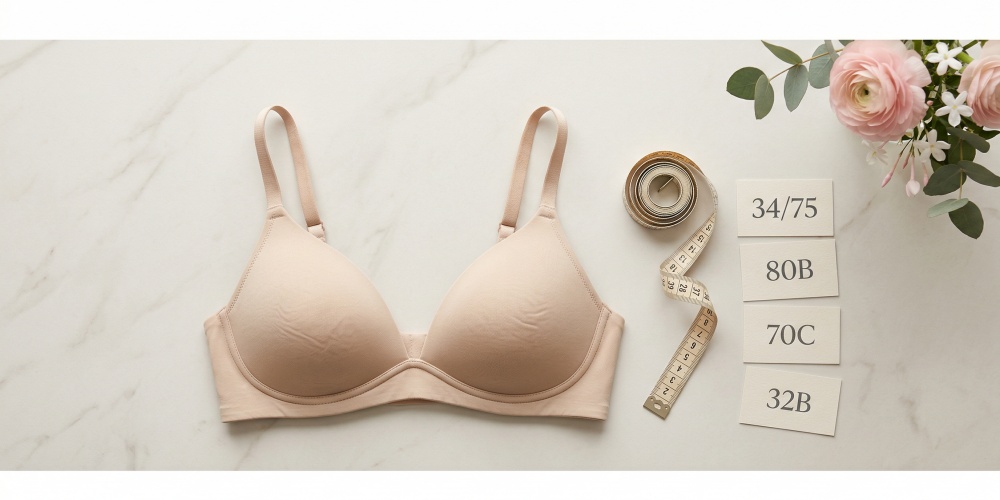
Bra Size Converter Explained: What 34/75, 80B, 70C, and Cup Sizes Really Mean
A bra size is never just B, C, or D. It is always a band size + cup size. The number—such as 70, 75, 80, 32, 34, or 36—tells you the band based on your underbust. The letter tells you the cup in relation to that band. That is why 80B, 75B, and 70B do not fit the same, and why 34/75 usually means the same band shown in two numbering systems. Once you read both parts together, bra size conversion becomes much easier.
34/75 usually means the same band shown in two formats. 80B means an 80 band with a B cup. 70C is commonly treated as 32C in international charts. And B, C, D do not mean much on their own, because cup size changes when band size changes.
The one rule worth remembering: never read the letter without the number.
What bra size actually means
If you want one rule to remember, remember this: the number anchors the fit, and the letter only makes sense after the number.
A bra size has two moving parts. The band size is the measurement around your ribcage, right under the bust. The cup size is based on the difference between your bust and underbust. That sounds simple, but most size confusion starts when people remember only the cup letter and forget that the band changes the meaning of that letter.
That is why a 70B, 75B, and 80B all share the same cup letter but do not fit the same. The band length is different, the cup scale is different, and the overall volume changes with the band. In other words, “I wear a B cup” is not a complete size in the same way “I wear size 75B” is.
If you have searched what does 34/75 mean, what is 80B, or is 70C the same as 32C, you are really asking one bigger question: how do different size systems describe the same body? That is exactly what this bra size converter guide is here to answer.
34/75, 36/80, 32/70: one chart to understand it fast
Some brands show bra bands in inches, such as 32, 34, 36. Others show them in centimeter-based labels, such as 70, 75, 80. In many Asia-facing stores, you will also see hybrid labels like 34/75B, where both systems are shown together for convenience.
| Hybrid label | Inch band | CM band | How to read it |
|---|---|---|---|
| 32/70 | 32 | 70 | Same band family shown in two systems |
| 34/75 | 34 | 75 | Same band family shown in two systems |
| 36/80 | 36 | 80 | Same band family shown in two systems |
| 38/85 | 38 | 85 | Same band family shown in two systems |
So, what does 34/75 mean? In most practical shopping contexts, it means the bra is showing the same band size in two ways:
- 34 = inch-based band label
- 75 = cm-based band label
- B / C / D = the cup part, which still must be read separately
That means 34/75B and 34/75C do not mean the same thing. The band family is the same, but the cup letter changes the fit.
Brands show both numbers because shoppers across regions often search differently. One person types 34/75. Another types 75B. Another searches 34B. A good pillar page has to connect those searches, not treat them as unrelated topics.
For a question-first version built around search intent, see 80B is how big? What does 34/75 mean?.
How to read 80B, 75C, and 70D
Now let’s decode the size patterns people search most often. Once you see how the number and letter work together, labels like 80B, 75C, and 70D stop feeling random.
80B
An 80 band with a B cup.
Common chart equivalent: 36B.
Useful sister sizes: 75C and 85A.
75C
A 75 band with a C cup.
Common chart equivalent: 34C.
Useful sister sizes: 80B and 70D.
70D
A 70 band with a D cup.
Common chart equivalent: 32D.
Useful sister sizes: 75C and 65E.
The comparison that helps most is this one: 75C = 80B = 70D in the classic sister-size family. They do not look identical on the hanger, but they are often used when the cup volume feels close enough and you need to adjust the band.
This also explains why 80B is not “bigger” than 75C in a simple way. It has a larger band and a lower cup letter, but those two changes balance each other. That is why shoppers who only compare letters often get misled.
Another useful example: 75B and 80B are not the same. The cup letter is the same, but the 80B has a larger band and a larger cup volume than 75B. Same letter does not mean same size.
Is 70C the same as 32C?
In common international conversion charts, yes: 70C is usually treated as 32C.
But the more useful answer is this: a chart gives you a conversion starting point, not a promise that every bra will feel identical. Fabric stretch, cup depth, wire shape, coverage level, and brand grading can all change how a 70C or 32C feels once you put it on.
So if you are shopping across Hong Kong, Taiwan, Singapore, and international sites, do not panic when you see different numbering. In many cases, the label has changed but the fit starting point has not.
Simple rule: treat 70C = 32C, 75C = 34C, and 80B = 36B as practical conversion references—then confirm with a fit check.
Why only looking at B, C, or D leads to the wrong size
This is the correction most shoppers need. A cup letter is not an absolute volume label. It only has meaning with a band.
That means:
- B is smaller than C only within the same band
- 80B is not the same cup volume as 70B
- 75B is not interchangeable with 70B
- “I’m a B cup” is not enough information to choose a bra
So what is the difference between 70B and 75B? The answer is simple:
- 70B = smaller band + smaller cup volume
- 75B = larger band + larger cup volume
That is also why the question “How big is B cup?” does not have one universal visual answer. A B cup on a 70 band is not the same as a B cup on an 80 band. Once you understand that, a lot of online bra confusion disappears.
Never shop by cup letter alone. Always read the band first, then the cup. The letter tells you nothing useful until the band is fixed.
What sister sizes are, and when to size up or down
Sister sizes are alternative bra sizes that keep a similar cup volume while changing the band. This is one of the most useful fitting tools to learn, especially when the bra feels almost right but not quite.
The easiest family to remember is:
Use sister sizing like this:
- If the band feels too tight, go up one band and down one cup
Example: 75C → 80B - If the band feels too loose, go down one band and up one cup
Example: 75C → 70D
Sister sizing works best when the cup feels mostly right and the band is the real problem. It is also useful when your usual size is sold out or when a particular style runs firm or stretchy in the band.
But it is not the answer to every fit problem. If the cups wrinkle, cut in, spill, or sit in the wrong place, you may need a different cup size, a different bra shape, or both. That is why sister sizing should be used as a fit adjustment tool—not as a shortcut for every discomfort issue.
If the numbers seem right but the bra still feels wrong, read how to tell if your bra is too big, too tight, or too small.
Common mistakes that make bra sizing feel harder than it is
1. Looking only at the cup letter
This is the most common mistake. B, C, and D do not stand alone.
2. Mixing up body measurement and bra measurement
A bra band may measure smaller when laid flat because the fabric is elastic. The label refers to the body measurement it is designed to fit.
3. Assuming all brands grade the same way
A size chart gives you a strong starting point, but fabric, support level, and cup shape still matter.
4. Measuring too loosely
If the underbust tape is not snug and level, your band size can drift upward and make the bra feel less supportive.
5. Treating conversion as a final answer
A bra size converter translates labels. It does not replace a real fit check.
One overlooked detail is the difference between the size on the tag and the bra laid flat on a table. Many shoppers worry when a labeled 75 band looks much smaller than 75 cm when they measure the product itself. That is normal. The band is elastic and built to stretch around the body. The size tag refers to the fit target, not always the flat fabric length.
How Hong Kong, Taiwan, and Singapore shoppers usually search this topic
One reason bra sizing feels unusually confusing in this region is that shoppers often search in different writing styles for the same question. A strong SEO and GEO article cannot explain only one format. It has to connect them all.
- Hong Kong: shoppers often search with hybrid label styles like 34/75 and 36/80.
- Taiwan: question-led searches like “80B is how big?” and “what does 34/75 mean?” are especially common.
- Singapore Chinese search: mixed English numbers and Chinese phrasing often appear together, such as “70C is 32C?” or “80B size”.
That is why this page explains inch labels, cm labels, cup logic, and sister sizing in one place. The user may type one format, but the answer almost always needs all four.
How to use a bra size calculator without overthinking it
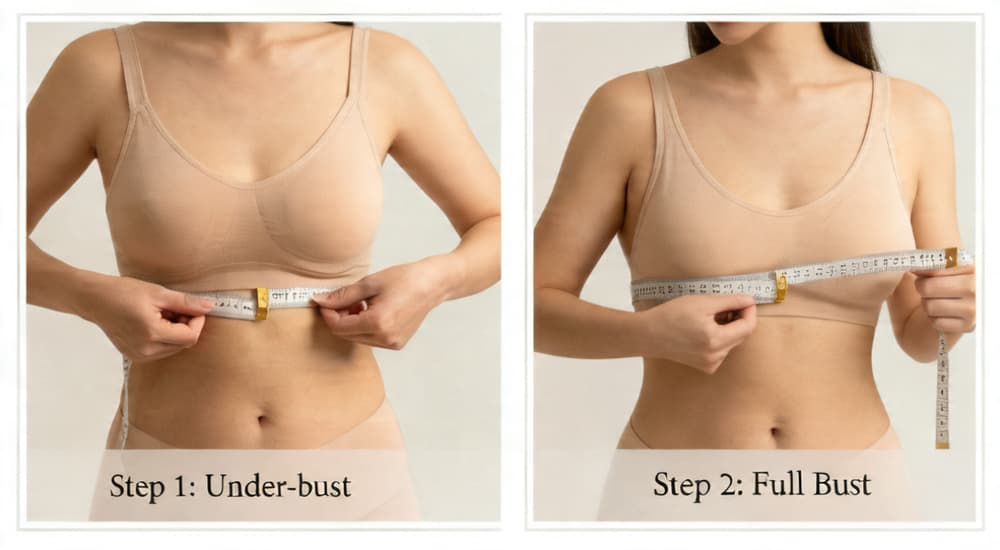
If you want the fastest route, use a bra size calculator built for lingerie sizing rather than guessing from an old tag. A good calculator asks for the two measurements that matter most:
- Your underbust, measured snugly
- Your overbust, measured at the fullest point
- A quick fit follow-up if you need a band or cup adjustment
The simplest process is:
- Measure your underbust snugly and level
- Measure your overbust at the fullest point
- Use both numbers together, not one alone
- Start with the recommended size
- Fine-tune with sister sizing only if the band feels off
VEIMIA’s official size page already gives you this path through its calculator and measuring guide. It is a better place to start than trying to remember old labels from different brands.
Once you know your size, the next question is usually style rather than numbers. For that step, read which breast shapes suit wireless bras.
Final takeaway
Bra size is not a random code. It is a two-part system: band first, cup second.
- 34/75 usually means the same band shown in two numbering systems
- 80B is commonly treated as 36B
- 70C is commonly treated as 32C
- 75C, 80B, and 70D are a classic sister-size family
- B, C, and D only make sense when the band is included
So the best sizing habit is also the simplest one: stop reading only the letter. Read the whole size. That one shift reduces guesswork, returns, and the frustration of buying a bra that looked right on the label but feels wrong on the body.
After you confirm your starting size, you can browse VEIMIA Best Selling as a light next step.
FAQ
What does 34/75 mean on a bra label?
It usually means the same band shown in two systems: 34 in an inch-based label and 75 in a cm-based label. You still need the cup letter to know the full size.
What is 80B in UK or US sizing?
80B is commonly treated as 36B in many international charts. Exact feel can still vary slightly by brand and bra shape.
Is 70C the same as 32C?
Usually, yes. On common conversion charts, 70C = 32C. In real wear, fabric stretch and cup construction can still make the fit feel a little different.
How big is B cup?
B cup is one step above A and one below C, but it is not a fixed volume on its own. 70B, 75B, and 80B are different sizes because the band changes the cup scale.
What is the difference between 70B and 75B?
75B has a larger band and a larger cup volume than 70B. They are not interchangeable just because both use the letter B.
Is 75C the same as 34C?
In many charts, yes. 75C is commonly treated as 34C, especially in cross-market shopping and band conversion references.
Why can a 75F bra measure smaller when laid flat?
Because the label refers to the body underbust the bra is designed to fit, while the band itself is elastic and may look smaller before stretching.
What should I do if the calculator size still feels wrong?
Check the band first, then the cup, then the bra shape. If the cup is fine but the band is off, try a sister size. If the whole fit feels wrong, use a fit-check guide and compare a different style.
Find Your Starting Size in Minutes
Measure your underbust and overbust once, then use the official VEIMIA Bra Size Calculator to translate labels like 34/75, 80B, and 70C into a more reliable starting size.


